Friday, 14 September 2018

The Life And Times Bashorun Of M.K.O Abiola.

The Life And Times Bashorun Of M.K.O Abiola.

Moshood Kashimawo Olawale Abiola (August 24, 1937 – July 7, 1998), often referred to as M. K. O. Abiola, was a popular Nigerian Yoruba businessman, publisher, politician and aristocrat of the Egba clan born in Abeokuta, Ogun State, Moshood was his father’s twenty-third child but the first of his father’s children to survive infancy.
MKO showed entrepreneurial talents at a very young age, at the tender age of nine he started his first business selling firewood. He would wake up at dawn to go to the forest and gather firewood, which he would then cart back to town and sell before going to school, in order to support his old father and his siblings
He later established a band at age fifteen where he performed at different functions in return of food. He in the end came to be acclaimed enough to begin requesting money for his exhibitions and utilized the cash to uphold his family and his optional instruction at the Baptist Boys High School Abeokuta, where he outperformed. He was the editor of the school magazine The Trumpeter, Olusegun Obasanjo was deputy editor. At the age of 19 he joined the National Council of Nigeria and the Cameroons apparently as a result of its container Africanist office, inclining toward it to the Obafemi Awolowo-led Action Group’s keep focus on investment and educational advancement for the Western Region of Nigeria, where the Yoruba were in the majority.
In 1956 Moshood Abiola started his professional life as bank clerk with Barclays Bank plc in Ibadan, South-West Nigeria. After two years he joined the Western Region Finance Corporation as an executive accounts officer before leaving for Glasgow, Scotland to pursue his higher education. In Glasgow he received 1st class in political economy, commercial law and management accountancy. He also received a distinction from the Institute of Chartered Accountants of Scotland. On his return to Nigeria, he worked as a senior accountant at the University of Lagos Teaching Hospital, then went onto Pfizer, before joining the ITT Corporation, where he later rose to the position of Vice President, Africa and Middle-East of the whole partnership, which was head-quartered in the United States. Therefore Moshood Abiola invested a considerable measure of his time and money in the United States, whilst holding the post of executive of the corporation’s Nigerian subsidiary.
Abiola invested heavily in Nigeria and West AfricaHe set up Abiola Farms, Abiola bookshops, Radio Communications Nigeria, Wonder bakeries, Concord Press, Concord Airlines, Summit oil international ltd, Africa Ocean lines, Habib Bank, Decca W.A. ltd, and Abiola football club. In addition to these, he also managed to perform his duties as Chairman of the G15 business council, President of the Nigerian Stock Exchange, Patron of the Kwame Nkrumah Foundation.
Moshood Abiola sprang to national and global prominence as a consequence of his humanitarian exercises. The Congressional Black Caucus of the United States of America issued the following tribute to Moshood Abiola
“Because of this man, there is both cause for hope and certainty that the agony and protests of those who suffer injustice shall give way to peace and human dignity. The children of the world shall know the great work of this extraordinary leader and his fervent mission to right wrong, to do justice, and to serve mankind. The enemies which imperil the future of generations to come: poverty, ignorance, disease, hunger, and racism have each seen effects of the valiant work of Chief Abiola. Through him and others like him, never again will freedom rest in the domain of the few. We, the members of the Congressional Black Caucus salute him this day as a hero in the global pursuit to preserve the history and the legacy of the African diaspora”
From 1972 until his death Moshood Abiola had been conferred with 197 traditional titles by 68 different communities in Nigeria, in response to the fact that his financial assistance resulted in the construction of 63 secondary schools, 121 mosques and churches, 41 libraries, 21 water projects in 24 states of Nigeria, and was grand patron to 149 societies or associations in Nigeria.
Moshood Abiola was twice voted worldwide businessman of the year, and gained various honorary doctorates from universities all over the world. In 1987 he was given the golden key to the city of Washington D.c., and he was bestowed with an award from the NAACP and  the King center in the USA, and also the International Committee on Education for Teaching in Paris, around numerous others. In Nigeria, the Oloye Abiola was made the Aare Ona Kakanfo of Yorubaland. It is the most noteworthy chieftancy title accessible to everyday citizens around the Yoruba, and has just been given by the tribe 14 times in its history. This basically rendered Abiola the ceremonial Viceroy of the greater part of his tribespeople. According to the folklore of the tribe as recounted by the Yoruba elders, the Aare Ona Kakanfo is expected to die a warrior in the defense of his nation inorder to prove himself in the eyes of both the divine and the mortal as having been worthy of his title.

Wednesday, 12 September 2018

photos of the burial of General Murtala Mohammed in Kano


Photos of General Murtala Mohammed's Corpse and Funeral


 photos of the burial of General Murtala Mohammed in Kano in 1976
 
General Murtala Mohammed was assassinated on February 13, 1976, a date that will never be forgotten in the history of Nigeria.
 
See photos from his funeral:


Life and times of Oba Erediauwa

Image result for oba erediauwa


Life and times of Oba Erediauwa

Born in 1923 as the first son of Oba Akenzua II, then Prince Solo­mon Aiseokhuoba Igbinoghodua Akenzua attended Government School, Benin from where he pro­ceeded to Government College, Ibadan in 1939, where he obtained with flying colours, his London Ma­triculations which qualified him to gain admission into Yaba College, Lagos in 1945.
At the end of his course at Yaba, he gained admission into King’s College, Cambridge to study Law and Administration.
He returned to Nigeria to join the Eastern Nigeria Civil Service as a District Officer (D.O) in 1957. He later transferred his service to the Federal Civil Service and rose to the position of Permanent Secretary.
Prince Solomon Akenzua retired from the service as Permanent Sec­retary, Ministry of Health in 1973 and became the regional represen­tative of Gulf Oil Company, now known as Chevron.
He was appointed Commissioner for Finance in the defunct Bendel State during the Military Adminis­tration of Major-General Agbazika Innih in 1975.
His early retirement from public service was to prepare him to handle the intricacies of the administrative challenges that would confront him in the performance of his duties as Oba of Benin, as his father, Oba Akenzua II under-studied his father, Eweka II whom he served as Private Secretary before his enthronement as Oba of Benin.
On Saturday, 23rd March, 1979, Prince Solomon AKenzua was crowned the 38th Oba of Benin with the title Omo N’Oba N’Edo, Uku Akpolokpolo, Erediauwa, CFR, Oba of Benin.
On the eve of his coronation, the sun and the moon reportedly ap­peared and created a partial eclipse, an occurrence that was interpreted to mean the Cosmic consent and endorsement of the coronation of the Oba to rule and reign over his people.
As a young prince and heir ap­parent, Oba Erediauwa was named Solomon-wise as King Solomon; Igbinoghodua- the Lord will be your strength and Aiseokhuoba-nobody should dare cause or invite your wrath by his grandfather, Oba Eweka II. These names and his title Erediauwa which means “one who has come to put the house and so­ciety in order”, have proved to be significant and instructive during his reign as the Oba of Benin.
Highly cerebral, one of the most revered traditional rulers in the country and always current with events, Oba Erediauwa’s reign wit­nessed peace and tranquillity and brought monumental transforma­tion to Benin, the Edo State capital. famous for its old mud houses with rustic zinc from ancient times to a modern city.
He demonstrated his love for development of the State and in particular, Benin City, when the du­alization of the Airport Road, Benin, was to commence.
At the time, the Peoples Demo­cratic Party (PDP) which had just lost power to then Action Congress (AC), was opposed to the project, claiming it was unnecessary and a waste of resources. A campaign was then mounted that the planned dual­ization would require the demolition of part of the Oba’s Palace. The es­sence of the campaign was to make Governor Adams Oshiomhole and his administration unpopular.
The Oba, obvioulsy interested in the development of Benin, reasoned differently and encouraged the proj­ect by personally adjusting the Pal­ace fence to pave way for the road dualization project, even when the State Government decided to shift the road to avoid impacting on the palace.
The road project, apart from be­ing a reality today, has changed the face of Benin.

Monday, 10 September 2018

Image result for cardinal arinzeImage result for cardinal arinze
Francis Arinze (born 1 November 1932) is a Nigerian Cardinal of the Roman Catholic Church. He was Prefect of the Congregation for Divine Worship and the Discipline of the Sacraments from 2002 to 2008. He has been the Cardinal Bishop of Velletri-Segni since 2005. Arinze was one of the principal advisors to Pope John Paul II and was considered papabile before the 2005 papal conclave, which elected Pope Benedict.

Early life

Arinze was born in Eziowelle, Anambra, Nigeria. A convert from an African traditional religion,[2] he was baptized on his ninth birthday (1 November 1941) by Father Michael Tansi, who was beatified by John Paul II in 1998. His parents later converted to Catholicism. At age 15, he entered All Hallows Seminary of Onitsha from which he graduated and earned a philosophy degree in 1950. His father was initially opposed to his entering the seminary, but after seeing how much Francis enjoyed it, he encouraged him. Arinze stayed at All Hallows until 1953 to teach. In 1955, he went to Rome to study theology at the Pontifical Urban University, where he ultimately earned a doctorate in sacred theology summa cum laude. On 23 November 1958, at the chapel of the university, Arinze was ordained to the priesthood by Gregorio Pietro Agagianian, pro-prefect of the Sacred Congregation for the Propagation of the Faith (Propaganda Fide).

As priest

After ordination, Father Arinze remained in Rome, earning a master's in theology in 1959 and doctorate in 1960. His doctoral thesis on "Ibo Sacrifice as an Introduction to the Catechesis of Holy Mass" was the basis for his much used reference work, "Sacrifice in Ibo Religion", published in 1970. From 1961 to 1962, Arinze was professor of liturgy, logic, and basic philosophy at Bigard Memorial Seminary. From there, he was appointed regional secretary for Catholic education for the eastern part of Nigeria. Eventually, Arinze was transferred to London, where he attended the Institute of Education and graduated in 1964.

Episcopate

Francis Arinze became the youngest Roman Catholic bishop in the world when he was consecrated on 29 August 1965, at the age of 32. He was appointed titular bishop of Fissiana and named Coadjutor to the Archbishop of Onitsha, Nigeria. He attended the final session of the Second Vatican Council in that same year. He became Archbishop of Onitsha on 26 June 1967. He was the first native African to head his diocese, succeeding Archbishop Charles Heerey, an Irish missionary.

As archbishop

The new Archbishop did not have much time to settle into his office before the Nigeria-Biafra War broke out. The entire archdiocese was located in the secessionist Biafran territory during the Nigerian Civil War. As a result of the war, Archbishop Arinze had to flee his see city of Onitsha and to live as a refugee, first in Adazi and then Amichi, for the three years of the war, which lasted from 1967 to 1970.
Despite his own refugee status, Archbishop Arinze worked tirelessly for refugees, displaced persons, the sick and the hungry, offering support to priests and religious, and giving the faithful hope for the future. With the help of foreign missionaries, he supervised what one international relief worker called one of "the most effective and efficient distributions of relief materials" in history. He also took care to keep the Church separate from the ongoing political conflict, gaining the respect of all factions in the country.
Francis Arinze was still Archbishop of Onitsha when the Nigeria-Biafra war ended in 1970. As a part of Biafra, Onitsha and its people had suffered greatly in the three-year war. The homes and businesses of the people had been devastated, and the already poor region was sinking deeper into poverty. The end of the war did not mean an end to the challenges facing the young Archbishop.
The Nigerian government deported all foreign missionaries stationed in the archdiocese, leaving only the native clergy and religious, who were few in number. The government also confiscated the Catholic schools, most of which also served as churches or parish halls.
Impressed by Arinze's many accomplishments as the leader of an archdiocese with few resources and his ability to work side by side with Muslims who represent a strong and not-to-be-ignored minority, Pope John Paul II in 1979 appointed Arinze pro-president of the Vatican's Secretariat for Non-Christians, later renamed the Pontifical Council for Interreligious Dialogue. Arinze continued as the ordinary of his archdiocese, and was elected unanimously as President of the Nigerian Bishops Conference in 1984.
A year later, the people of Onitsha organized a pilgrimage to Rome when they learned that Archbishop Arinze would be named a Cardinal at the Consistory of 25 May 1985.

Cardinalate


On 8 April 1985, Arinze resigned from his post in Onitsha, and the Pope named him a Cardinal-Deacon of San Giovanni della Pigna in the consistory held on 25 May 1985; he was raised to the rank of cardinal-priest in 1996. Two days following his elevation to cardinal deacon, Arinze was appointed President of the Pontifical Council for Interreligious Dialogue.
He served in various related capacities including the president of the Special Assembly for Africa of the Synod of Bishops. He also received honours in this capacity: On 24 October 1999 he received a gold medallion from the International Council of Christians and Jews for his outstanding achievements in inter-faith relations. He traveled extensively and became a popular speaker in the United States.
Arinze was a member of the Committee of the Great Jubilee of the Year 2000. In that capacity, he worked closely with individual bishops and priests throughout the world in preparation for the rare celebration of the Church. On 1 October 2002, Pope John Paul named him prefect of the Congregation for Divine Worship and the Discipline of the Sacraments.
When Pope John Paul II died on 2 April 2005, all major Vatican officials – including Arinze – automatically lost their positions. He was considered papabile, that is, a candidate for election to the papacy, at the papal conclave that followed, in which he was a cardinal elector.[3] He returned to his post as prefect of the Congregation for Divine Worship when confirmed by the newly elected Pope Benedict XVI on 21 April 2005, and on 25 April Benedict named him Cardinal Bishop of Velletri-Segni.
On 9 December 2008 Benedict accepted the resignation of Arinze as prefect of the Congregation of Divine Worship. His successor, who took office that same day, is Cardinal Antonio Cañizares Llovera. On his eightieth birthday on 1 November 2012 Cardinal Arinze lost his eligibility to participate and vote in any future conclaves occurring as the result of any period of sede vacante.
Arinze remains active and in 2009 gave the commencement address at the Augustine Institute in Denver. He actively catechises via Familyland TV to the Americas, the Philippines, Africa, and Europe. He has produced over 1,700 television programs with the Apostolate for Family Consecration. The programs cover almost all of Pope John Paul II's encyclicals and apostolic letters, Vatican II, and many other topics. In July 2009, he delivered a major speech promoting interreligious dialogue at The City Club of Cleveland.[5] He is also the author of several books along with a complete "Consecration and Truth Catechetical Program" for children and adults.

NAMES OF PRINCIPAL COUP PLOTTERS OF JULY 28 1966

The 1966 Nigerian counter-coup, or the so-called "July Rematch", was the second of many military coups in Nigeria. It was masterminded by Lt. Colonel Murtala Muhammed[1] and many northern military officers. The coup began as a mutiny at roughly midnight on July 28, 1966 and was a reaction to the killings of Northern politicians and Officers by mostly Igbo soldiers on January 15, 1966  The July mutiny/counter coup resulted in the murder of Nigeria's first military Head of State General Johnson Aguiyi-Ironsi and Lt Colonel Adekunle Fajuyi (who was hosting a visiting Aguiyi-Ironsi) in Ibadan by disgruntled northern non-commissioned officers (NCOs). Upon the termination of Ironsi's government, Lt. Colonel Yakubu Gowon was appointed Head of State by the July 1966 coup conspirators.

Reasons for the counter-coup

According to historian Max Siollun northern soldiers had a list of grievances following the aborted January 15, 1966, coup which led to the planning of the counter-coup. A list of their grievances were:
  • The murder of northern civilian leaders and military officers in the aborted January 15, 1966, coup d'etat
  • The January 15, 1966, coup conspirators (mostly Majors) had not been tried for treason and were being paid while in detention
  • The passage of the Unification Decree
  • Rumors of an "Igbo coup" to eliminate northern soldiers
  • The promotion of several Igbo Majors to Lt. Colonel
  • Rumors of General Aguiyi-Ironsi's ethnic favoritism toward Igbos
  • Plans to swap the 1st and 4th battalions and plans to rotate the military governors of the different regions

Coup participants

The principal coup plotters are listed below:
  • Lt. Colonel Joseph Akahan (Commander, 4th Bataillon Kaduna)
  • Lt. Colonel Murtala Muhammed (Inspector of Signals, Lagos)
  • Major Theophilus Danjuma (Principal Staff Officer, Army HQ, Lagos)
  • Major Abba Kyari (Artillery, Kaduna)
  • Major Martin Adamu (2nd Battalion Lagos)
  • Major Shittu Alao (Nigerian Airforce HQ, Lagos)
  • Major Musa Usman (Nigerian Air Force, Lagos)
  • Captain Joseph Garba (Federal Guards Lagos)
  • Captain Isa Bukar (Federal Guards Lagos)
  • Captain Ibrahim Taiwo (Lagos Garrison Yaba)
  • Captain Baba Usman GSO (Grade II, Army HQ, Lagos)
  • Captain Abdul D.S. Wya (3rd Battalion, Kaduna)
  • Lieutenant Muhammadu Buhari (2 Brigade Lagos)
  • Lieutenant Ibrahim Babangida (1st Reconnaissance Squadron, Kaduna)
  • Lieutenant Ibrahim Bako (4th Battalion, Ibadan)
  • Lieutenant William Walbe (2nd Battalion, Lagos)
  • Lieutenant Mamman Vatsa (4th Battalion, Ibadan)
  • Lieutenant Buka Suka Dimka (Nigerian Military Training College Kaduna)
  • Lieutenant Yakubu Dambo (3rd Battalion Kaduna)
  • Lieutenant Garba A. Dada (Adjutant 4th Battalion Ibadan)
  • Lieutenant Garba Duba (1 Reconnaissance Squadron Kaduna)
  • Lieutenant Mohammed Balarabe Haladu (4th Battalion, Ibadan)
  • Lieutenant Malami Mahe Nassarawa (2nd Battalion, Lagos)
  • Lieutenant James Onoja (4th Battalion, Ibadan)
  • Lieutenant Abdulahhi Shelleng (Company Commander, 4th Battalion, Ibadan)
  • Lieutenant Paul Chabri Tarfa (Federal Guards, Lagos)
  • Lieutenant D.S. Abubakar (Abeokuta Garrison)
  • Second Lieutenant Sani Abacha (3rd Battalion Kaduna)
  • Second Lieutenant Muhammadu Gado Nasko (Artillery, Kaduna)
  • Sergeant Paul Dickson
  • Sergeant Sabo Kwale (Abeokuta Garrison)
  • Corporal John Shagaya (2nd Reconnaissance Squadron, Abeokuta)

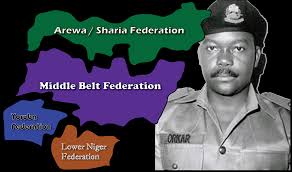
The April 22,1990 Coup Speech By MAJOR GIDEON ORKAH


Fellow Nigerian Citizens,Image result for THE GIDEON ORKAR COUP SPEECHImage result for THE GIDEON ORKAR COUP SPEECH

On behalf of the patriotic and well-meaning peoples of the Middle Belt and the southern parts of this country, I , Major Gideon Orkar, wish to happily inform you of the successful ousting of the dictatorial, corrupt, drug baronish, evil man, deceitful, homo-sexually-c­­entered, prodigalistic, un-patriotic administration of General Ibrahim Badamosi Babangida.

We have equally commenced their trials for unabated corruption, mismanagement of national economy, the murders of Dele Giwa, Major-General Mamman Vasta, with other officers as there was no attempted coup but mere intentions that were yet to materialize and other human rights violations.

The National Guard already in its formative stage is disbanded with immediate effect. Decrees Number 2 and 46 are hereby abrogated. We wish to emphasize that this is not just another coup but a well-conceived,­­ planned and executed revolution for the marginalized, oppressed and enslaved peoples of the Middle Belt and the south with a view to freeing ourselves and children yet unborn from eternal slavery and colonization by a clique of this country.

Our history is replete with numerous and uncontrollable instances of callous and insensitive dominatory repressive intrigues by those who think it is their birthright to dominate till eternity the political and economic privileges of this great country to the exclusion of the people of the Middle Belt and the south.

They have almost succeeded in subjugating the Middle Belt and making them voiceless and now extending same to the south.

It is our unflinching belief that this quest for domination, oppression and marginalization­­ is against the wish of God and therefore, must be resisted with the vehemence.

Anything that has a beginning must have an end. It will also suffice here to state that all Nigerians without skeleton in their cupboards need not to be afraid of this change. However, those with skeleton in their cupboards have all reasons to fear, because the time of reckoning has come.

For the avoidance of doubt, we wish to state the three primary reasons why we have decided to oust the satanic Babangida administration.­­ The reasons are as follows:

(a) To stop Babangida’s desire to cunningly, install himself as Nigeria’s life president at all costs and by so doing, slowpoke the progress of this country for life. In order to be able to achieve this undesirable goals of his, he has evidently started destroying those groups and sections he perceived as being able to question his desires.

Examples of groups already neutralized, pitched against one another or completely destroyed are:

(1) The Sokoto caliphate by installing an unwanted Sultan to cause division within the hitherto strong Sokoto caliphate.

(2) The destruction of the peoples of Plateau State, especially the Lantang people, as a balancing force in the body politics of this country.

(3) The buying of the press by generous monetary favors and the usage of State Security Service, SSS, as a tool of terror.

(4) The intent to cow the students by the promulgation of the draconian decree Number 47.

(5) The cowing of the university teaching and non-teaching staff by an intended massive purge, using the 150 million dollar loan as the necessitating factor.

(6) Deliberately withholding funds to the armed forces to make them ineffective and also crowning his diabolical scheme through the intended retrenchment of more than half of the members of the armed forces.

Other pointers that give credence to his desire to become a life president against the wishes of the people are:

(1) His appointment of himself as a minister of defense, his putting under his direct control the SSS, his deliberate manipulation of the transition programme, his introduction of inconceivable, unrealistic and impossible political options, his recent fraternization with other African leaders that have installed themselves as life presidents and his dogged determination to create a secret force called the national guard, independent of the armed forces and the police which will be answerable to himself alone, both operationally and administrativel­­y.

It is our strong view that this kind of dictatorial desire of Babangida is unacceptable to Nigerians of the 1990’s, and, therefore, must be resisted by all.

Another major reason for the change is the need to stop intrigues, domination and internal colonization of the Nigerian state by the so-called chosen few. This, in our view, has been and is still responsible for 90 percent of the problems of Nigerians.

This indeed has been the major clog in our wheel of progress.

This clique has an unabated penchant for domination and unrivalled fostering of mediocrity and outright detest for accountability,­­ all put together have been our undoing as a nation.

This will ever remain our threat if not checked immediately. It is strongly believed that without the intrigues perpetrated by this clique and misrule, Nigeria will have in all ways achieved developmental virtues comparable to those in Korea, Taiwan, Brazil, India, and even Japan.

Evidence, therefore, this cancerous dominance has as a factor constituted by a major and unpardonable clog in the wheel of progress of the Nigerian state. It is suffice to mention a few distasteful intrigues engineered by this group of Nigerians in recent past. These are:

(1) The shabby and dishonorable treatment meted on the longest serving Nigerian general in the person of General Domkat Bali, who in actual fact had given credibility to the Babangida administration.

(2) The wholesale hijacking of Babangida’s administration by the all-powerful clique.

(3) The disgraceful and inexplicable removal of Commodore Ebitu Ukiwe, Professor Tam David-West, Mr. Aret Adams and so on from office.

(4) The now-pervasive and on-going retrenchment of Middle Belt and southerners from public offices and their instant replacement by the favoured class and their stooges.

(5) The deliberate disruption of the educational culture and retarding its place to suit the favoured class to the detriment of other educational minded parts of this country.

(6) The deliberate impoverishment of the peoples from the Middle Belt and the south, making them working ghosts and feeding on the formulae of 0-1-1- or 0-0-0 while the aristocratic class and their stooges are living in absolute affluence on a daily basis without working for it.

(7) Other countless examples of the exploitative, oppressive, dirty games of intrigues of its class, where people and stooges that can best be described by the fact that even though they contribute very little economically to the well-being of Nigeria, they have over the years served and presided over the supposedly national wealth derived in the main from the Middle Belt and the southern part of this country, while the people from these parts of the country have been completely deprived from benefiting from the resources given to them by God.
The third reason for the change is the need to lay a strong egalitarian foundation for the real democratic take off of the Nigerian state or states as they circumstances may dictate.

In the light of all the above and in recognition of the negativeness of the aforementioned aristocratic factor, the overall progress of the Nigerian state a temporary decision to excise the following states namely, Sokoto, Borno, Katsina, Kano and Bauchi states from the Federal Republic of Nigeria comes into effect immediately until the following conditions are met.

The conditions to be met to necessitate the re-absorption of the aforementioned states are as following:

(a) To install the rightful heir to the Sultanate, Alhaji Maccido, who is the people’s choice.

(b) To send a delegation led by the real and recognized Sultan Alhaji Maccido to the federal government to vouch that the feudalistic and aristocratic quest for domination and operation will be a thing of the past and will never be practiced in any part of the Nigeria state.

By the same token, all citizens of the five states already mentioned are temporarily suspended from all public and private offices in Middle Belt and southern parts of this country until the mentioned conditions above are met.

They are also required to move back to their various states within one week from today. They will, however, be allowed to return and joint the Federal Republic of Nigeria when the stipulated conditions are met.

In the same vein, all citizens of the Middle Belt and the south are required to come back to their various states pending when the so-called all-in-all Nigerians meet the conditions that will ensure a united Nigeria. A word is enough for the wise.

This exercise will not be complete without purging corrupt public officials and recovering their ill-gotten wealth, since the days of the oil boom till date. Even in these hard times, when Nigerians are dying from hunger, trekking many miles to work for lack of transportation,­­ a few other Nigerians with complete impunity are living in unbelievable affluence both inside and outside the country.

We are extremely determined to recover all ill-gotten wealth back to the public treasury for the use of the masses of our people. You are all advised to remain calm as there is no cause for alarm. We are fully in control of the situation as directed by God. All airports, seaports and borders are closed forthwith.

The former Armed Forces Ruling Council is now disbanded and replaced with National Ruling Council to be chaired by the head of state with other members being a civilian vice-head of state, service chiefs, inspector general of police, one representative each from NLC, NUJ, NBA, and NANS.

A curfew is hereby imposed from 8 p.m. to 6 a.m. until further notice. All members of the armed forces and the police forces are hereby confined to their respective barracks.

All unlawful and criminal acts by those attempting to cause chaos will be ruthlessly crushed. Be warned as we are prepared at all costs to defend the new order.

All radio stations are hereby advised to hook on permanently to the national network programme until further notice.

Long live all true patriots of this great country of ours. May God and Allah through his bountiful mercies bless us all".

April 22,1990.
Lagos,Nigeria.
MAJOR GIDEON ORKAH

The Assassination of Kudirat Abiola in Lagos on June 4, 1996

Alhaja Kudirat Abiola was the beautiful wife of the late business mogul and respected politician, Chief Moshood Kashimawo Olawale Abiola. She was very active and socially conscious during her days. The tireless support she gave to her husband, M.K.O Abiola, when he was incarcerated pulled the string of her death. On the 4th of June, 1996, Kudirat Abiola was assassinated by some gunmen in Lagos allegedly on the orders of the Sani Abacha military junta.
After President Ibrahim Babangida annulled the June 12, 1993 election which declared M.K.O as the new democratic president of Nigeria, several riots sparked throughout the country, especially the Western Region. The winner of the annulled election, M.K.O Abiola, seeing his right denied, declared himself as the President which led to his arrest; he was convicted on the charges of treason and felony. This was during the military regime of Gen. Sani Abacha. The concerted effort Kudirat Abiola made to get her husband out of jail and also to get him his mandate brought her across the line of the military government. In 1994, Kudirat Abiola spearheaded an oil workers strike against the government which lasted for 12 months. She also gathered market women, students and civil servants to fight for their electoral right which was denied on June 12, 1993. Unknowing to Kudirat Abiola, she had been marked for elimination.
On June 4, 1996, Alhaja Kudirat Abiola was driven in a white Mercedes Benz V-Boot by her driver and accompanied by her (Kudirat) special assistant, Lateef Shofolahan. It was around 3pm, the car was sailing the streets of Lagos; as the car slowed down around 7-Up Depot/Bus Stop in Ikeja, six heavily armed men emerged from a car and opened fire on Kudirat Abiola’s car. The range of the shooting was close and the driver got his mouth and shoulder pierced by a bullet, and Kudirat too, the main target, was hit in the forehead and instantly lost consciousness. She was rushed to the Highbrow Eko Hospital but eventually died. However, Kudirat’s personal assistant, Lateef Shofolahan, escaped the attack unhurt. He was later accused of being involved in the murder plot of Kudirat Abiola. Oldnaija.com gathered that prior to Alhaja Kudirat’s murder, there were two attempts to take her life before the plotters allegedly penetrated her through Lateef Shofolahan, her personal assistant. The Abacha government that allegedly killed Kudirat Abiola offered the sum of $45,000 to anyone who could give information leading to the arrest of the assassins.
Major Hamza al-Mustapha
Major Hamza al-Mustapha 
Later, Hamza Al-Mustapha, the chief security officer of General Sani Abacha, was accused and convicted of his involvement in Kudirat Abiola’s death. Investigations into the killing traced the killer bullet to his (Hamza Al-Mustapha) personal amoury. In October 1988, Hamza Al-Mustapha and Mohammed Abacha, Gen. Abacha’s son, appeared before the court, both charged with the death of Kudirat Abiola. In the court, Mohammed Abdul, one of the assassins, narrated how the Abiola’s network was penetrated through Lateef Shofolahan, and how Mohammed Abacha gave him and other assassins $10,000 to flee the country when Obasanjo’s government began investigation on Kudirat Abiola’s murder. He said, “I was then given a car key to a 504 saloon car. Sumaila Shuaibu was driving the 505 car while I drove the 504. We went to the National theatre where we met Alhaji Lateef Shofolahan (Kudirat Abiola’s P.A) who took us to Festac town where he pointed at one house. From there, we went to Surulere and then to Mr. James Danbaba’s house. Rabo Lawal asked from the security men if the CP was in, before he went inside and spent some time there. We then went back to Dodan Barracks. In the evening Alhaji Lateef came to meet us at Dodan Barracks and together we went to Victoria Island where Alhaji Lateef pointed a house to Rabo Lawal who was in the same car with him. From V.I. we went to Surulere and then to Igbosere Road. Alhaji Lateef then went inside one storey building on a street near Igbosere close to Sura market”.

Another member of the killer squad, Barnabas Jabila aka Seargent Rogers, confessed that he was acting on the orders of Hamza Al-Mustapha and that he (Hamza Al-Mustapha) gave the contract to kill Kudirat Abiola to Rabo Lawal, the head of the mobile police force at the presidential villa. He also said that they were provided weapons for the operation in the presence of Mohammed Abacha.

How The Kidnap Of Umaru Dikko From London Was Foiled In 1984

In London in 1984, a team of Nigerians and Israelis attempted to kidnap and repatriate the exiled former Nigerian minister Umaru Dikko. Mr Dikko, who had fled Nigeria after a military coup, was accused of stealing $1bn (£625m) of government money.
The plot was foiled by a young British customs officer, Charles David Morrow, who has now told the BBC World Service Witness programme what happened.
On a summer's day, Mr Dikko walked out of his front door in an upmarket neighbourhood of Bayswater in London. Within seconds he had been grabbed by two men and bundled into the back of a transit van.
"I remember the very violent way in which I was grabbed and hurled into a van, with a huge fellow sitting on my head - and the way in which they immediately put on me handcuffs and chains on my legs," he told the BBC a year later.
Mr Dikko had been minister for transport in the government of Shehu Shagari until it was overthrown by the military at the end of 1983. He fled to London accused by Nigeria's new rulers of embezzlement - a charge he has always denied.
Labelled "Nigeria's most wanted man", a plot was hatched to get both him and the money back.
The extraordinary plan was to kidnap Mr Dikko, drug him, stick him into a specially made crate and put him on a plane back to Nigeria - alive.
Israeli anesthetist
An Israeli alleged former Mossad agent, Alexander Barak, was recruited to lead the kidnap team. It included a Nigerian intelligence officer, Maj Mohammed Yusufu, and Israeli nationals Felix Abitbol and Dr Lev-Arie Shapiro, who was to inject Mr Dikko with an anesthetic.
Umaru Dikko always denied embezzling $1bn
The kidnappers switched vehicles in a car park by London Zoo and headed towards Stansted airport where a Nigerian Airways plane was waiting. They injected Mr Dikko and laid him, unconscious, in a crate.
Umaru Dikko in his younger daysThe Israeli anesthetist climbed into the crate as well, carrying medical equipment to make sure Mr Dikko didn't die en route. Barak and Abitbol got into a second crate. Both boxes were then sealed.
At the cargo terminal of Stansted Airport, 40 miles (64km) north of London, a Nigerian diplomat was anxiously waiting for the crates to arrive. Also on duty that day was a young customs officer, Charles David Morrow.
Diplomatic bag
"The day had gone fairly normally until about 3pm. Then we had the handling agents come through and say that there was a cargo due to go on a Nigerian Airways 707, but the people delivering it didn't want it manifested," Mr Morrow said.
"I went downstairs to see who they were and what was happening. I met a guy who turned out to be a Nigerian diplomat called Mr Edet. He showed me his passport and he said it was diplomatic cargo. Being ignorant of such matters, I asked him what it was, and he told me it was just documents and things."

A missing persons bulletin alerted customs officials to the kidnapping
No-one on duty at Stansted had dealt with a diplomatic bag before and Mr Morrow went to check the procedure.
Just then a colleague returned from the passenger terminal with some startling news. There was an All Ports Bulletin from Scotland Yard saying that a Nigerian had been kidnapped and it was suspected he would be smuggled out of the country.
The police had been alerted by Mr Dikko's secretary who had witnessed his abduction from a window in the house.
Hearing the news, Mr Morrow realised he had a problem on his hands.

"I just put two and two together. The classic customs approach is not to look for the goods, you look for the space," he said.
"So I am looking out of the window and I can see the space which is these two crates, clearly big enough to get a man inside. We've got a Nigerian Airways 707, which we don't normally see. They don't want the crates manifested, so there would be no record of them having gone through. And there was very little other cargo going on board the aircraft.
"If you want to hide a tree, you hide it in the forest. You don't stick it out in the middle of Essex."
By the book
But any cargo designated as a diplomatic bag is protected by the Vienna Convention from being opened by customs officers. So Mr Morrow got on the phone to the British Foreign Office.
"To qualify as a 'diplomatic bag' they clearly had to be marked with the words 'Diplomatic Bag' and they had to be accompanied by an accredited courier with the appropriate documentation. It was fair to say they had a Nigerian diplomat - I'd seen his passport - but they didn't have the right paperwork and they weren't marked 'Diplomatic Bag'," he said.
The decision was taken that the crates could be opened - but it would be done by the book. That required the presence of a Nigerian diplomat, but as Mr Morrow pointed out, one was already on hand. By now, the crates were up on special trolleys ready to be loaded on to the plane.
"Peter, the cargo manager, hit the lid on the bottom and lifted it. And as he lifted it, the Nigerian diplomat, who was standing next to me, took off like a startled rabbit across the tarmac," Mr Morrow said.
"You have to remember we are on an airfield which is square miles of nothing. He ran about five yards (4.5m), realised no-one was chasing him and then stopped.
"Peter looked into the crate and said: 'There's bodies inside!'
He parked a forklift truck so its tines lay across the top of the crate so it couldn't be opened. Mr Morrow dialled the emergency number 999.
"My name's Morrow, from Customs at Stansted. We've got some bodies in a crate. Do you think you can send someone over," he recalls saying.

"They said: 'Alive or Dead?'
"I said: 'That's a very good point. I don't know.'
"They said: 'We'll send an ambulance as well.'"
After half an hour, police started to arrive, and they opened the second crate. Inside they found an unconscious Mr Dikko, and a very much awake Israeli anaesthetist. Mr Dikko was lying on his back in the corner of the crate.
"He had no shirt on, he had a heart monitor on him, and he had a tube in his throat to keep his airway open. No shoes and socks and handcuffs around his ankles. The Israeli anaesthetist was in there, clearly to keep him alive," recalls Mr Morrow.
The kidnappers in the other crate were unrepentant. They said Mr Dikko was the biggest crook in the world.
The Nigerian intelligence officer and the three Israelis all received prison sentences in the UK.
Diplomatic relations between the UK and Nigeria broke down and were only fully restored two years later. The Nigerian and Israeli governments have always denied involvement in the kidnapping.
Mr Dikko returned to Nigeria the following decade.
Mr Morrow was commended for actions that day by the head of UK Customs, who described the incident as a "very tricky situation".

Oba Kosoko: His Military Strength And The Struggle For Lagos Kingship

Oba Kosoko was a member of the Ologun Kutere Lagos Royal Family who reigned as Oba of Lagos from 1845 to 1851. His father was Oba Esin...